

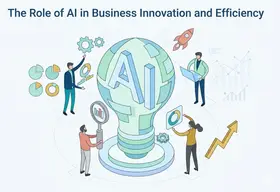
AI in Business: Driving Innovation and Efficiency in 2026
Discover how AI in business drives innovation, improves efficiency, and enhances customer experience. Learn key applications, benefits, challenges, and implementation strategies.
The Impact of AI in Business: Applications, Benefits, and Strategies
Artificial Intelligence (AI) is transforming how businesses operate, compete, and grow in the digital era. From automating repetitive tasks to enabling data-driven decision-making, AI is helping organisations unlock new levels of efficiency and innovation.
As AI adoption continues to rise, businesses that leverage this technology effectively can gain a significant competitive advantage. This guide explores the role of AI in business, its applications, benefits, challenges, and best practices for successful implementation.
Understanding Artificial Intelligence in Business
What is AI in Business?
AI in business refers to the use of intelligent computer systems to perform tasks that typically require human intelligence, such as problem-solving, learning, and decision-making.
The Role of Data in AI
Data is the foundation of AI systems. AI algorithms analyse large datasets to:
Identify patterns
Make predictions
Generate actionable insights
High-quality data is essential for accurate and reliable AI outcomes.
Business Value of AI
AI delivers measurable value across organisations by:
Enhancing decision-making with real-time insights
Enabling personalisation for better customer experiences
Improving operational efficiency
Key Applications of AI in Business
1. Customer Service and Support
AI Chatbots: Provide instant, 24/7 customer support
Virtual Assistants: Tools like voice assistants improve user interaction and convenience
2. Data Analytics and Business Intelligence
Predictive Analytics: Forecast trends and customer behaviour
Sentiment Analysis: Understand customer opinions and brand perception
3. Marketing and Sales
Recommendation Engines: Deliver personalised product suggestions
Lead Scoring: Identify high-quality prospects and improve conversions
4. Supply Chain and Logistics
Demand Forecasting: Optimise inventory and reduce waste
Route Optimisation: Improve delivery efficiency and reduce costs
AI-Driven Innovation in Business

Product and Service Innovation
Rapid prototyping using AI tools
Generative design for innovative product development
Research and Development
Faster drug discovery through data analysis
Advanced material research for new technologies
Business Process Innovation
Automation of repetitive workflows
Intelligent task management and process optimisation
Benefits of AI in Business
Increased Efficiency
AI automates repetitive tasks, saving time and reducing operational costs.
Better Decision-Making
AI provides data-driven insights, helping businesses make smarter and faster decisions.
Enhanced Customer Experience
Personalised interactions improve customer satisfaction and loyalty.
Competitive Advantage
Businesses that adopt AI early can outperform competitors and adapt quickly to market changes.
Challenges of AI Implementation
Data Quality and Privacy
Poor-quality data can lead to inaccurate results, while data privacy concerns must be carefully managed.
Talent and Skills Gap
A shortage of skilled AI professionals can slow down adoption.
Integration with Existing Systems
Implementing AI into legacy systems can be complex and costly.
Ethical Concerns
Bias, fairness, and transparency must be addressed to ensure responsible AI use.
Strategies for Successful AI Implementation
Align AI with Business Goals
Focus on AI initiatives that deliver measurable business value.
Strengthen Data Management
Implement strong data governance, quality control, and security practices.
Invest in AI Talent
Upskill employees or hire experts to support AI development and deployment.
Start with Pilot Projects
Test AI solutions through small-scale projects before full implementation.
Ethical AI Practices

Bias Mitigation
Regularly audit AI systems to ensure fairness and eliminate bias.
Transparency and Explainability
Make AI systems understandable to build trust with users and stakeholders.
Accountability and Governance
Establish clear responsibility and oversight for AI-driven decisions.
Conclusion
AI is revolutionising the business world by driving innovation, efficiency, and smarter decision-making. While challenges exist, businesses that adopt AI strategically and ethically can unlock its full potential.
By focusing on data quality, ethical practices, and clear business alignment, organisations can successfully integrate AI and stay ahead in an increasingly competitive digital landscape.
Frequently Asked Questions (FAQ)
What is AI in business?
AI in business refers to using intelligent systems and algorithms to automate tasks, analyse data, and improve decision-making processes.
How is AI used in business operations?
AI is used in customer service, marketing, sales, data analytics, supply chain management, and process automation.
What are the benefits of AI for businesses?
AI improves efficiency, enhances customer experience, enables better decision-making, and provides a competitive advantage.
What are the challenges of implementing AI?
Common challenges include data quality issues, lack of skilled professionals, integration difficulties, and ethical concerns.
How can businesses successfully implement AI?
Businesses should align AI with goals, invest in data and talent, start with pilot projects, and follow ethical practices.
Ready to Get Started?
Let's discuss how we can help you achieve your goals