

AI Search Optimization vs SEO: What Local Businesses Need to Know in 2026
The way customers search for local services has fundamentally changed. Traditional SEO once focused on ranking websites in Google search results. Today, people increasingly ask AI assistants like ChatGPT, Google Gemini, and Perplexity who they should hire. This shift from search engines to AI-driven answers introduces a new layer of digital visibility: AI Search Optimization (ASO). For local businesses that depend on online leads, understanding the difference between SEO and ASO—and how they work together—is critical. Businesses that fail to adapt risk becoming invisible in AI-generated recommendations, even if they rank well on Google.
What Is SEO?
The Foundation of Organic Search Visibility
Search Engine Optimization (SEO) is the process of improving a website’s visibility in traditional search engines such as Google and Bing. It focuses on optimizing content, keywords, backlinks, site structure, and technical performance to rank higher in search results.
How SEO Works
Search engines crawl and index your website
Algorithms evaluate relevance, authority, and user experience
Pages are ranked based on keyword intent and trust signals
Why SEO Still Matters
SEO remains essential for long-term organic traffic, website authority, and credibility. Google search still drives a significant share of local business leads, and strong SEO improves page speed, usability, and conversion rates.
SEO builds the foundation—but it no longer covers the full search ecosystem.
What Is AI Search Optimization (ASO)?
The Next Evolution of Search Visibility
AI Search Optimization (ASO) focuses on optimizing your business for AI-generated answers and recommendations, not just search rankings.
Instead of competing for blue links, ASO ensures your business is recognized, trusted, and cited by AI systems when users ask conversational questions with local intent.
How AI Search Optimization Works
AI assistants analyze websites, reviews, FAQs, citations, and structured data
They generate summarized, conversational answers
ASO ensures your business is included in those answers across AI platforms
Why ASO Exists
As AI assistants replace traditional search result pages, ranking position matters less than being recommended. Businesses optimized only for Google risk being excluded from AI-generated responses entirely.
ASO ensures your business is visible where modern customers are actually searching—through conversation.
SEO vs AI Search Optimization: Key Differences
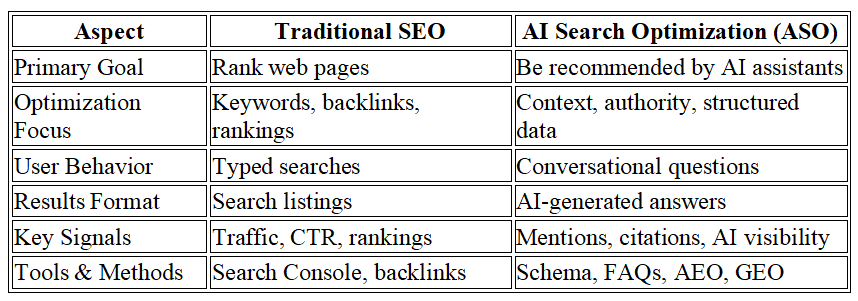
In short:
SEO helps people find you.
ASO helps AI recommend you.
Local businesses need both for full digital visibility.
Core Components of AI Search Optimization
Answer Engine Optimization (AEO)
AEO ensures your business becomes the direct answer to AI questions like “Who’s the best electrician near me?”
This relies on clear content structure, FAQs, and schema that establish topical authority.
Generative Engine Optimization (GEO)
GEO helps your business appear inside AI-generated summaries, such as Google’s Search Generative Experience (SGE).
It focuses on structured data, clarity, and contextual trust signals.
AI Conversion Systems
Visibility alone isn’t enough. Once AI sends traffic or leads, automated AI systems can qualify, schedule, and follow up instantly—bridging discovery and conversion.
Why Local Businesses Need ASO

Voice and Conversational Search Are Now Standard
Customers no longer search with short keywords. They ask full questions like:
“Who’s the best emergency plumber open right now?”
Without ASO, your business may never appear in these answers.
AI Influences Buying Decisions
Consumers increasingly trust AI-generated recommendations. If your business isn’t optimized for AI interpretation, competitors will be suggested instead.
Local SEO Doesn’t Cover AI Platforms
Google Business Profiles and keyword SEO help with search results—but they don’t control how AI assistants choose answers. ASO fills that gap.
Structured Data Builds Trust
AI relies on clean, consistent, structured information. Businesses with accurate schema, FAQs, and citations are far more likely to be referenced.
How to Optimize for Both SEO and ASO
1. Maintain Strong Technical SEO
Fast load times
Mobile-first design
Secure, crawlable architecture
2. Implement Structured Data
LocalBusiness, Service, and FAQ schema
Clear service areas, hours, and contact details
3. Optimize for Conversational Queries
Create content that answers real questions customers ask—naturally and clearly.
4. Publish Authoritative Content
Long-form guides, service explainers, and case studies increase trust for both search engines and AI systems.
5. Strengthen Reputation Signals
AI evaluates reviews, citations, and consistency across platforms like Google, Yelp, and social profiles.
SEO + ASO: A Complete Visibility Strategy
SEO builds authority and long-term organic reach.
ASO earns AI recommendations and real-time visibility.
Together, they ensure your business is discoverable across Google search, AI assistants, voice search, and generative platforms—now and in the future.
Conclusion
The shift from traditional search results to AI-driven recommendations is already happening.
Local businesses relying only on SEO will gradually lose visibility as AI assistants become the primary decision-makers. Those that adopt AI Search Optimization early will earn more recommendations, more leads, and a stronger competitive edge.
The future of search belongs to businesses that optimize for both humans and machines.
FAQ:
What is the difference between SEO and AI Search Optimization?
SEO focuses on ranking websites in search engines, while ASO focuses on being recommended by AI assistants and generative search systems.
Do local businesses still need SEO if AI search is growing?
Yes. SEO provides the foundation of authority and trust that AI systems rely on when generating answers.
How do AI assistants choose which businesses to recommend?
They analyze structured data, content clarity, reviews, citations, authority signals, and contextual relevance.
Can AI Search Optimization replace local SEO?
No. ASO complements SEO. Businesses need both to remain visible across all search and AI platforms.
When should a local business start optimizing for AI search?
Now. AI-driven search is already influencing customer decisions, and early adopters gain a long-term advantage.
Ready to Get Started?
Let's discuss how we can help you achieve your goals