
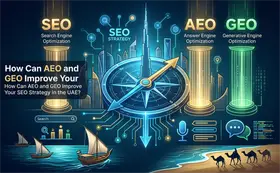
How Can AEO and GEO Improve Your SEO Strategy in the UAE?
Artificial Intelligence is transforming SEO, and to stay ahead, businesses need to adopt AEO (Answer Engine Optimization) and GEO (Generative Engine Optimization). AEO focuses on getting your content featured in direct answers, like Google snippets and voice search, while GEO ensures AI models recognize your content as a trusted source for generating responses. By creating clear, conversational, and authoritative content with structured data, brands can boost visibility, trust, and engagement in AI-driven search results.
AEO and GEO: The Future of SEO
The SEO landscape is evolving fast, and AI is changing the game entirely. To stay ahead, businesses need to understand AEO (Answer Engine Optimization) and GEO (Generative Engine Optimization). These strategies don’t replace traditional SEO—they enhance it, helping your content appear in direct answers and AI-driven results.
What is AEO and How It Works
While traditional SEO focuses on ranking on search results pages, AEO targets direct answers, like Google’s featured snippets, voice search responses, or instant answers. The goal is to position your content as the definitive solution to a user’s query.
Key Features of AEO:
Understand User Intent
AEO focuses on why someone is searching, not just the keywords they type.
Example: For the query “best coffee machine,” AEO asks: “Which coffee machine is reliable, affordable, and easy to clean?”
Structured, Clear Content
Use FAQs, bullet points, numbered lists, and clear headings.
Implement schema markup and structured data for context and authority.
Answer Questions Directly
Provide concise, definitive answers to common queries.
Lead with the answer first, then add supporting details.
Optimize for Conversational Search
Write in a natural, question-based style using words like how, what, why.
Ideal for voice search and AI-driven responses.
Establish Authority
Content from reliable sources with clear, factual information is prioritized.
What is GEO and How It Works
GEO (Generative Engine Optimization) takes things a step further by preparing your content to be cited and referenced by AI models like ChatGPT or Google AI Overviews. It ensures AI recognizes your brand as a trusted source of information.
Key Elements of GEO:
Conversational Content
Write for humans while keeping AI readability in mind.
Provide clear answers while maintaining a natural, engaging tone.
Semantic Depth
Go beyond surface-level answers. Include detailed explanations, examples, and related entities.
Helps AI understand context and relevance.
Structured Data Markup
Use schema and structured tags to signal the content’s purpose.
Real-Time Accuracy
Keep your content factual, updated, and timely.
AI prefers reliable, current information.
How GEO Works
For content to succeed in GEO:
AI-Friendly Structure
Organize with headings, clean formatting, and clear explanations.
Make it easy for AI to crawl and interpret.
Conversational Style
Content should feel like a natural conversation, readable for both humans and AI.
E-E-A-T Alignment
Experience: Show you’ve done it firsthand.
Expertise: Demonstrate deep knowledge in your field.
Authoritativeness: Establish credibility in your niche.
Trustworthiness: Ensure content is accurate and reliable.
When these elements are applied, AI-driven search engines recognize your content as a trusted, high-value source.
Key Takeaways
AEO: Helps your content appear in direct answers and voice search results.
GEO: Positions your content as a trusted source for AI models.
Both: Work alongside SEO to improve overall visibility, trust, and engagement.
Focus on humans first, AI second: Clear, conversational, and authoritative content wins.
By combining SEO, AEO, and GEO strategies, your website becomes future-proofed for AI-driven search, ensuring visibility, credibility, and relevance in 2026 and beyond.
Frequently Asked Questions
1. What is the difference between SEO, AEO, and GEO?
SEO improves your ranking on search results pages.
AEO optimizes content to appear in direct answers and featured snippets.
GEO ensures AI models cite and reference your content in AI-generated responses.
2. Will AEO or GEO replace traditional SEO?
No. They enhance SEO by improving visibility in AI-driven search and voice search, complementing your existing strategy.
3. How do I start optimizing for AEO?
Identify common questions your audience asks.
Use structured formats like FAQs, bullet points, and headings.
Write clear, concise, and conversational content.
4. How do I optimize for GEO?
Provide deep, contextual content with semantic richness.
Use structured data and schema markup.
Maintain up-to-date, accurate, and trustworthy information.
5. How long does it take to see results?
Results vary by competition and content quality, but improvements often appear within 3–6 months for both AEO and GEO optimizations.
Ready to Get Started?
Let's discuss how we can help you achieve your goals