

How Do GEO Optimization Strategies Boost Brand Visibility?
Website referrals from large language models (LLMs) have surged 800% year-over-year in just the past three months. This explosive growth signals a fundamental shift in how consumers discover and engage with brands—and it’s happening faster than most marketing teams anticipated. Traditional SEO strategies that once dominated digital discovery are losing ground as AI-powered platforms like ChatGPT, Perplexity, and Google AI Overviews reshape the way users find information. With ChatGPT surpassing 400 million users as of February 2025, brands that leverage Generative Engine Optimization (GEO) now have a massive opportunity to increase visibility, engagement, and conversions. For growth-stage companies, the question is no longer whether to invest in GEO—it’s how quickly you can implement strategies that drive measurable ROI. Early adopters build competitive advantages that compound over time, while those who delay risk becoming invisible.
Key Takeaways
Explosive Growth: AI-driven website referrals increased 800% YoY, making early GEO adoption critical for competitive advantage.
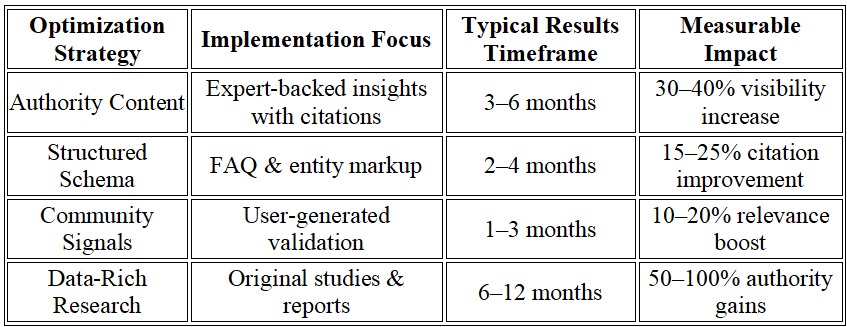
Authority-Driven Content Matters: Structured data, expert insights, and comprehensive FAQ schemas can boost AI visibility by 30–40% compared to standard content.
Measure AI Impact: Track AI-specific metrics like AI-Generated Visibility Rate (AIGVR) and AI Engagement Citation Rate (AECR) to quantify success.
Cross-Channel Amplification: Consistent entity references across video, podcasts, social media, and technical documentation enhance GEO outcomes.
Speed Over Perfection: Establish authority signals early to secure lasting advantages before AI markets become saturated.
Why GEO is a Competitive Advantage in 2025
Generative Engine Optimization ensures your brand appears prominently in AI-generated responses on platforms like ChatGPT, Perplexity, Gemini, and other large language models. Unlike traditional SEO—which focuses on ranking in search results—GEO prioritizes citations and contextual relevance within AI responses.
Case Study: Smart Rent
By restructuring their content to be AI-readable and fixing technical SEO barriers, Smart Rent achieved:
100% increase in citations across ChatGPT, Perplexity, and Gemini
50% lift in AI Overview mentions
“Brands investing in GEO today are building digital moats. It’s not just visibility—it’s authoritative presence in the AI knowledge graphs powering responses.” – Industry Analysis, 2025
Early GEO implementation is essential because AI platforms train on existing web content. Delaying optimization risks missing a critical window where early adoption creates long-term brand authority.
Core GEO Strategies for Measurable Results
Successful GEO requires a systematic approach prioritizing authority, structure, and semantic connectivity. The goal is content that is discoverable, citable, and contextually relevant to AI systems.
1. Authority-Driven Content
Include expert-backed citations, statistics, and original research
Clear hierarchies, definitive statements, and data-backed insights improve AI trust
Example: Bierman Autism improved Core Web Vitals and earned 100% more citations in Gemini and 75% AI Overview capture
2. Structured Data & Semantic Connectivity
Use comprehensive FAQ schema, consistent entity references, and content clusters around core topics
Helps AI models understand relationships between concepts, improving citation frequency
Example: LS Building Products implemented topic clusters around product categories, driving a 229% increase in conversion rates
Measuring GEO ROI
GEO success relies on AI-specific metrics:
AI-Generated Visibility Rate (AIGVR): Frequency your content appears in AI-generated responses
AI Engagement Citation Rate (AECR): Depth of engagement and citation frequency by AI models
Revenue Attribution: Track branded search spikes, referral traffic from conversational AI, and AI-influenced touchpoints
Brands with high AECR often see compound growth, as repeated AI citations reinforce authority and drive high-converting traffic.
Advanced GEO Tactics for Enterprise Growth
Enterprise-level GEO strategies focus on scalable content architecture:
Conduct content audits to identify AI optimization opportunities
Map competitive positioning within AI citation networks
Prioritize content updates based on revenue potential
Apply Answer Everywhere Optimization (AEO) for scalable cross-channel consistency
Cross-Channel Integration
AI optimization isn’t limited to website content:
Video transcripts
Podcast descriptions
Social media posts
Technical documentation
Unified entity references and messaging across all channels amplify authoritative presence and improve citation rates.
Future-Proofing Your GEO Strategy
AI continues to evolve rapidly. Forward-thinking GEO strategies emphasize:
Adaptability: Continuous testing and refinement
Cross-Functional Teams: Dedicated GEO experts across marketing, content, and technical teams
Proactive Monitoring: Tools and dashboards for AI platform tracking
Speed of Implementation: Early authority signals secure lasting advantages
Early movers will benefit from long-term brand authority within AI knowledge ecosystems, creating competitive barriers that are increasingly difficult for rivals to overcome.
FAQ: Generative Engine Optimization
Q1: What is GEO?
Generative Engine Optimization (GEO) is the process of optimizing content to be discovered, understood, and cited by AI platforms like ChatGPT, Perplexity, and Google AI Overviews. Unlike traditional SEO, GEO focuses on citations and authority rather than search rankings.
Q2: Why is GEO important for brands in 2025?
AI platforms process billions of queries daily, and early GEO adoption positions your brand as an authoritative source. Brands implementing GEO see higher referral traffic, more AI citations, and stronger market recognition.
Q3: How do I implement GEO effectively?
Focus on authority-driven content, structured data like FAQ schemas, content clusters, and consistent entity references. Measure AI visibility (AIGVR) and engagement (AECR) to track results.
Q4: How long does it take to see results from GEO?
Authority content: 3–6 months
Structured schema: 2–4 months
Data-rich research and original studies: 6–12 months
Q5: How do GEO results compare to traditional SEO?
GEO drives AI-driven referrals, citations, and engagement, often resulting in higher conversion rates than standard search traffic because AI platforms pre-qualify users before they visit your site.
Q6: Can GEO work across multiple content channels?
Yes. Video transcripts, podcasts, social media, technical documentation, and blog content all contribute to AI visibility. Consistent entity references and messaging amplify results.
Q7: What is the biggest factor for GEO success?
Speed of implementation is critical. Early authority signals in AI knowledge graphs create lasting competitive advantages that compound over time.
Ready to Get Started?
Let's discuss how we can help you achieve your goals