


How Will GEO Marketing Transform Your Content Strategy in 2026?
Generative Engine Optimization (GEO marketing) has evolved far beyond traditional geographic targeting. In 2026, GEO represents a comprehensive approach to AI-powered content optimization, ensuring your brand thrives in generative search environments while delivering precise, contextually relevant experiences to your audience.
Unlike traditional SEO, which prioritized keywords and rankings, GEO marketing focuses on answering real questions in conversational language—content that both humans and AI systems can understand. AI platforms like Google Gemini, ChatGPT, and Perplexity evaluate content based on helpfulness, accuracy, and contextual relevance, not keyword density.
“The future belongs to brands that understand context beats keywords every time. GEO marketing transforms static pages into dynamic, conversational assets that AI engines actively recommend.”
GEO marketing isn’t just about search visibility—it transforms your entire content ecosystem, from audience research to measurement, creating content that feels natural in AI-generated responses while driving measurable business outcomes.
The Four Pillars of GEO-Driven Content Transformation
1. Intent Mapping Beyond Demographics
Traditional strategies segment audiences by demographics or firmographics. GEO marketing goes deeper, mapping the actual questions, concerns, and decision-making patterns driving search behavior.
Example for B2B SaaS: A VP of Marketing doesn’t just search for “marketing automation.” They ask:
“How do I prove marketing attribution to the board?”
“What’s the real ROI timeline for marketing automation implementation?”
GEO ensures your content anticipates and answers these precise queries, guiding prospects through the buying journey.
2. Conversational Content Architecture
GEO transforms static content hierarchies into fluid, conversational experiences.
Develop FAQ-style content and anticipate follow-up questions
Create natural transitions between related topics
Use AI tools like ChatGPT to identify conversational patterns, but leverage human insight to contextualize answers
This approach ensures AI systems recommend your content and human readers find it relevant and engaging.
3. Contextual Personalization at Scale
GEO marketing personalizes content based on industry, role, company size, and buyer journey stage, not just inserting names into templates.
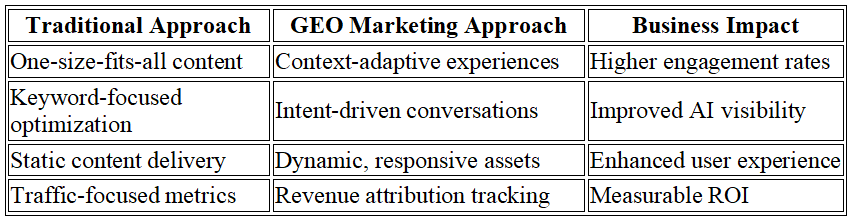
4. AI-Native Optimization
GEO requires content optimized for AI recommendation engines:
Structured answers AI systems can confidently cite
Accuracy and expertise that build trust with AI algorithms and human audiences
Clear, authoritative content that reinforces brand authority
Real-World GEO Marketing Success Stories

LS Building Products: AI-Optimized Growth
By implementing GEO and AI SEO strategies, LS Building Products:
Achieved 67% organic traffic growth
Increased domain rating by 20%
Generated 400% more traffic value
Bierman Autism: Google Gemini Visibility
A GEO-driven approach addressing technical SEO and content strategy led to:
21% improvement in keyword rankings
100% increase in visibility on Google Gemini
These case studies demonstrate GEO’s ability to drive measurable ROI beyond traditional SEO metrics.
Measuring GEO Marketing ROI
The transition to GEO requires new measurement frameworks that link content performance to revenue outcomes:
AI citation frequency
Conversation completion rates
Multi-touch attribution across the buyer journey
Sophisticated teams combine intent scoring with engagement metrics to identify which content pieces generate qualified pipeline, not just traffic.
Implementation Framework: The GEO Content Flywheel
Successful GEO marketing follows a systematic four-phase approach:
Discovery Phase
Map audience conversational patterns and search behaviors
Identify the specific questions driving engagement
Creation Phase
Develop conversational content addressing identified intent patterns
Ensure content is AI-citable and human-readable
Optimization Phase
Refine content based on AI feedback, engagement, and conversion metrics
Continuously test and improve
Scale Phase
Systematize successful content strategies across your library
Use AI assistance and automation to expand reach and maintain quality
Budget Allocation for GEO Marketing in 2026
The market momentum behind GEO is significant: B2B companies are projected to spend $10.11 billion on MarTech in 2026, a 16% YoY increase.
Forward-thinking CMOs allocate budgets as follows:
Technology infrastructure: 40%
Content creation & optimization: 35%
Measurement & analytics: 25%
ROI is measured through customer acquisition cost reductions, increased lifetime value, and AI-driven visibility metrics rather than traditional vanity metrics.
Overcoming Common GEO Marketing Challenges
Content Quality vs Scale: Develop templates that balance personalization with production efficiency.
Technical Integration: Ensure new AI-focused tools integrate with existing marketing stacks.
Measurement Complexity: Use advanced analytics to track conversation completion and multi-touch attribution.
Competitive Advantage Through Early GEO Adoption
Early adopters gain:
Larger libraries of optimized content
Sophisticated understanding of audience intent
Stronger AI recommendation signals
GEO marketing improves user experience, brand authority, and qualified lead generation, compounding across channels and securing a long-term competitive moat.
Future-Proofing Content Strategy
GEO isn’t a one-time project; it’s an evolution in content strategy. Forward-thinking organizations:
Develop adaptive content capabilities
Train teams on conversational and AI-optimized content
Establish measurement frameworks that evolve with AI search technology
The brands that succeed will integrate GEO into every content decision, focusing on intent, conversational relevance, and measurable outcomes.
Ready to transform your content strategy? Partner with leading GEO and AI SEO specialists to unlock AI-driven visibility and measurable ROI.
FAQ: GEO Marketing
Q1: What is GEO marketing?
GEO marketing (Generative Engine Optimization) focuses on optimizing content for AI search engines and conversational platforms, ensuring your brand is cited and referenced in AI-generated answers.
Q2: How is GEO different from traditional SEO?
Traditional SEO targets keyword rankings and website traffic. GEO targets AI citations, conversational relevance, and authority, prioritizing visibility in AI-generated responses.
Q3: Why is GEO important for B2B companies?
B2B buyers increasingly use AI for vendor discovery and research. GEO ensures your brand is visible, authoritative, and trusted early in the buyer’s journey.
Q4: What are the key GEO strategies?
Intent mapping beyond demographics
Conversational content architecture
Contextual personalization at scale
AI-native optimization with structured answers
Q5: How long does it take to see results from GEO marketing?
Initial improvements in AI visibility can appear within 2–3 months, while full content flywheel effects may take 6–12 months as AI systems recognize authority.
Q6: How do companies measure GEO ROI?
Key metrics include: AI citation frequency, conversation completion rates, multi-touch attribution, and revenue impact. These go beyond traditional traffic and engagement metrics.
Q7: Can GEO marketing work with existing SEO efforts?
Yes. GEO complements SEO by enhancing authority, conversational content, and AI visibility, creating an integrated search strategy for maximum impact.
Ready to Get Started?
Let's discuss how we can help you achieve your goals