What Are the Top Digital Marketing Tools for Business Success in 2026?
Digital marketing is the use of digital channels, data, and technology to achieve marketing objectives, engage customers, and influence their buying decisions. It allows businesses to quickly collect and analyze consumer behavior, respond to trends, and deliver personalized communication that drives engagement and sales. Modern marketing prioritizes personalization and rapid interaction, focusing on the customer’s preferences, desires, and online behavior rather than just the product or service.
Key Digital Marketing Performance Indicators
To measure and optimize digital marketing efforts, companies must monitor several critical aspects:
1. Competitor Analysis
Understanding competitors’ strategies helps identify market opportunities, avoid mistakes, and generate ideas for social media posts, videos, and other content to attract the target audience.
2. Target Audience Analysis
Knowing your audience is essential for effective targeted advertising, efficient lead generation, and maximizing conversions with minimal costs.
3. Promotion Strategy Development
A comprehensive strategy includes:
Building a sales funnel
Calculating advertising budgets
Increasing brand awareness through social media posts, videos, and campaigns
Boosting engagement and interactions with potential clients
4. Lead Generation
Collecting a database of potential customers and their preferences is crucial. Lead generation campaigns can encourage users to provide contact information, while educational content may simply raise awareness and build interest.
Key Digital Marketing Tools

Social Media Marketing (SMM)
SMM promotes a company on platforms like Instagram, Facebook, TikTok, LinkedIn, and YouTube. Its popularity surged during the global shift to online interaction, especially after COVID-19.
Benefits of SMM:
Regular engagement: Social media keeps your brand visible even when users aren’t actively seeking your products.
Builds loyalty: Effective content can generate trust and increase repeat purchases.
Versatile strategy: Includes content planning, competitor and audience analysis, posting frequency, and performance tracking.
Challenges:
Requires frequent content updates (at least every 2 days)
Continuous monitoring of trends and user interests
High competition and constant innovation in content formats
Monthly analytics to assess engagement and reach
Targeted Advertising
Targeted ads reach the audience most likely to engage with your brand. They are typically set up via social media ad accounts and can appear on social platforms or partner sites.
Advantages:
Tailored to demographics, interests, location, and online behavior
Enhances the effectiveness of SMM campaigns
Tracks consumer behavior to optimize future campaigns
Contextual Advertising
Contextual advertising appears on search engines, websites, or landing pages based on a user’s search query or browsing behavior.
Pay-Per-Click (PPC) is the main model, where advertisers pay for each click. PPC campaigns can include lead forms and quizzes to collect potential customer data.
SEO Optimization
Search Engine Optimization (SEO) improves website visibility in search engine results. It involves:
Keyword research and semantic core collection
On-page and technical SEO
Mobile optimization, site speed improvements, and secure connections
Enhancing content to boost conversions
SEO works alongside PPC and other digital marketing efforts to drive organic traffic and improve ROI.
Email Marketing
Email marketing builds engagement, strengthens brand awareness, and increases conversions. Campaigns may include:
Exclusive offers and discounts
Tips, guides, and educational content
Product recommendations and reminders
Advantages:
Cost-effective and measurable
Highly personalized and targeted
Automates follow-ups, reminders, and greetings
Strengthens brand awareness
Challenges:
Risk of emails being marked as spam
Competing in crowded inboxes
Compliance with regulations (GDPR, CAN-SPAM)
Maintaining engaging, high-quality content
Influencer Marketing
Influencer marketing leverages bloggers, social media personalities, and celebrities to promote products. Platforms like YouTube, Instagram, TikTok, and Facebook are commonly used.
Pros:
Can generate high ROI quickly
Demonstrates products in authentic formats like unboxings or reviews
Cons:
High costs, not sustainable for all campaigns
ROI depends on influencer credibility and audience engagement
Capabilities and Limitations of Digital Marketing
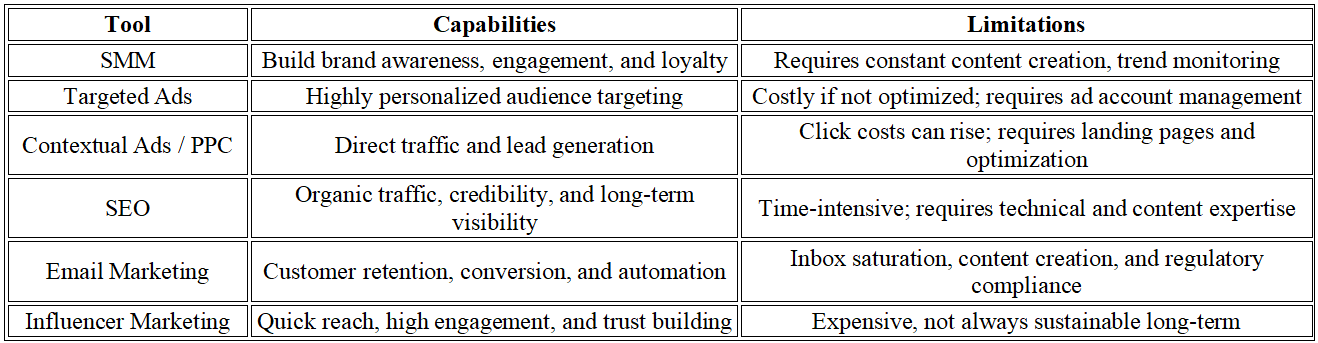
With the rise of AI and machine learning, digital marketing tools can now predict consumer behavior, automate personalization, and optimize campaigns at scale. Staying updated with technology trends ensures your business delivers relevant solutions and unique experiences to customers.
Frequently Asked Question
Q1: What is digital marketing?
Digital marketing is the use of online channels, data, and technology to promote products, engage customers, and influence their purchasing decisions.
Q2: What are the main digital marketing tools?
Key tools include SMM (social media marketing), targeted advertising, contextual advertising/PPC, SEO, email marketing, and influencer marketing.
Q3: How does SMM help my business?
SMM builds brand awareness, engages audiences regularly, increases loyalty, and drives sales through social media platforms.
Q4: What is the difference between targeted and contextual advertising?
Targeted advertising focuses on specific audiences, usually on social media.
Contextual advertising appears based on user search queries or website content, often on search engines.
Q5: Why is SEO important for digital marketing?
SEO increases organic website traffic, improves search engine rankings, and enhances visibility, supporting all other marketing campaigns.
Q6: What are the benefits of email marketing?
Email marketing is cost-effective, personalized, measurable, and strengthens customer loyalty through automated campaigns.
Q7: Is influencer marketing effective?
Yes, influencer marketing can generate rapid engagement and ROI, but it is costly and not a long-term replacement for other marketing strategies.
Q8: How can AI improve digital marketing?
AI and machine learning analyze consumer data, predict behavior, automate personalization, and optimize campaigns, making marketing more efficient and effective.
Ready to Get Started?
Let's discuss how we can help you achieve your goals