


What Is Generative Engine Optimization (GEO)? A Complete SEO Guide for 2026
In today’s AI-driven search landscape, Generative Engine Optimization (GEO) is redefining how brands earn visibility online. As AI-powered search tools and large language models reshape how users discover information, businesses must go beyond traditional SEO tactics. Instead of only ranking on search engine results pages (SERPs), brands now need to be cited, summarized, and referenced inside AI-generated answers. GEO is the strategy that makes this possible.
Understanding Generative Engine Optimization (GEO)
Generative Engine Optimization (GEO) is the process of optimizing digital content so that AI-powered search engines and generative models can easily understand, trust, and reference it in their responses.
Traditional SEO focuses on:
Ranking for keywords
Driving organic traffic
Improving click-through rates
GEO focuses on:
Being cited in AI-generated summaries
Becoming a trusted data source for answer engines
Ensuring accurate brand representation in conversational AI
As search engines integrate generative AI experiences, users increasingly receive direct answers instead of lists of links. GEO ensures your content becomes part of those answers.
Why GEO Matters in Modern Search
Search behavior has changed dramatically. Users now expect:
Instant, concise answers
Conversational interactions
Trusted summaries from AI
When your brand is referenced inside an AI-generated response, you gain:
Higher perceived authority
Brand recognition without requiring a click
Increased trust and visibility
In many cases, AI citation visibility can be as valuable as a #1 organic ranking.
GEO vs. SEO: What’s the Difference?
Although GEO and SEO share the goal of improving visibility, their execution differs.
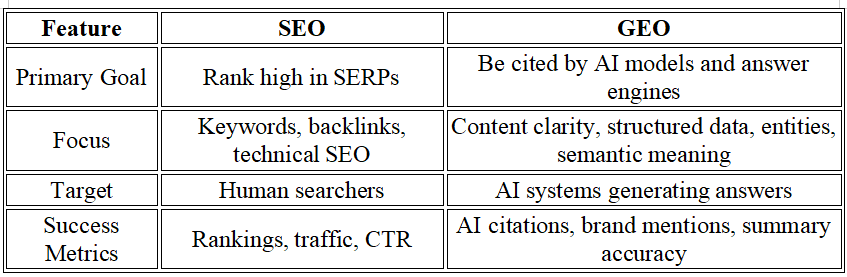
SEO drives users to your website.
GEO embeds your expertise directly into AI conversations.
Both are essential for a future-ready digital strategy.
Core Strategies for Effective Generative Engine Optimization
1. Semantic Content Optimization
AI models prioritize meaning over keyword repetition.
To optimize effectively:
Write clearly and directly
Fully explain concepts
Avoid unnecessary jargon
Provide complete answers to common questions
Think in terms of topics and intent, not just keywords.
2. Implement Structured Data (Schema Markup)
Structured data helps AI models understand your content context.
Add schema for:
FAQs
Products
Services
Articles
Definitions
Schema markup acts as a blueprint that makes your content machine-readable and easier to cite.
3. Create Entity-Based Content
AI systems rely heavily on entities (people, brands, locations, concepts).
Improve your GEO by:
Building dedicated pages around core topics
Clearly defining industry terminology
Providing factual, attribute-rich descriptions
Maintaining consistent naming conventions
Strong entity clarity improves AI recognition and citation probability.
4. Establish Authority and Trust
Generative engines prioritize reliable sources.
To increase trust signals:
Publish well-researched, fact-checked content
Cite reputable sources
Build topical authority
Maintain consistent expertise in your niche
Authoritative domains are more likely to be referenced in AI summaries.
5. Design Conversational, Question-Led Content
Since AI search is conversational, structure your content accordingly:
Use natural language
Add FAQ sections
Write direct answers under clear headings
Anticipate user questions
Content formatted in Q&A style increases extraction accuracy for generative models.
6. Strengthen Internal & External Linking
AI models analyze relationships between content.
Improve contextual signals by:
Linking related articles internally
Referencing credible external sources
Maintaining logical content hierarchies
This enhances semantic structure and topical depth.
The Future of Search: AI-First Visibility
Generative AI is not a passing trend—it’s a structural shift in search behavior.
As AI systems improve at:
Understanding context
Synthesizing information
Delivering real-time answers
Brands that adopt GEO early will:
Maintain visibility despite declining click-through rates
Increase brand authority
Future-proof their digital marketing strategy
GEO isn’t replacing SEO—it’s evolving it.
Frequently Asked Questions (FAQ) About Generative Engine Optimization
What is Generative Engine Optimization (GEO)?
Generative Engine Optimization (GEO) is the process of optimizing content so AI-powered search engines and generative models can understand, cite, and reference it in AI-generated answers and summaries.
Is GEO replacing traditional SEO?
No. GEO complements SEO. While SEO focuses on ranking in traditional search results, GEO focuses on being referenced within AI-generated responses. Both strategies are necessary for modern digital visibility.
How is GEO different from SEO?
SEO prioritizes keyword rankings and backlinks.
GEO prioritizes semantic clarity, structured data, entity recognition, and content accuracy to improve AI citation visibility.
Why is GEO important for businesses?
As more users rely on AI-generated answers instead of browsing multiple websites, brands must ensure they are represented inside those AI responses. GEO increases brand exposure, authority, and trust in AI-powered search experiences.
How can I start implementing GEO today?
Start with:
Creating semantically rich content
Adding structured data (Schema markup)
Building clear entity-based topic clusters
Publishing authoritative, research-backed content
Writing conversational, question-focused sections
Monitor how AI systems summarize your content and continuously refine for clarity and accuracy.
Ready to Get Started?
Let's discuss how we can help you achieve your goals