


What Is the Complete Guide to Generative Engine Optimization (GEO)?
The rules of search have permanently changed. While brands were optimizing for Google’s blue links, AI platforms quietly reshaped how people find information. Today, tools like ChatGPT, Perplexity AI, and Claude answer millions of questions directly—often without sending users to a website. Meanwhile, Google AI Overviews now appear in a significant portion of search results, summarizing information instantly at the top of the page. The implication is clear: If your brand isn’t being cited by AI systems, you’re not just losing clicks—you’re losing visibility. Welcome to the era of Generative Engine Optimization (GEO). This guide explains how to optimize your content for AI engines, earn citations across multiple platforms, and position your brand as a trusted source that generative systems rely on.
What Is Generative Engine Optimization (GEO)?
Generative Engine Optimization (GEO) is the practice of making your content discoverable, understandable, and quotable by AI systems that generate direct answers.
Traditional SEO aims to rank web pages.
GEO aims to make your content part of the answer itself.
Instead of optimizing for position #1, you optimize to be:
Cited
Referenced
Summarized
Trusted
When AI platforms synthesize responses, they select authoritative sources. GEO ensures your brand is one of them.
GEO vs Traditional SEO: What’s Different?
Traditional SEO Model
User enters a query.
Search engine ranks websites.
User clicks multiple results.
Success = traffic and rankings.
GEO Model
User asks an AI assistant a question.
AI synthesizes information from multiple sources.
AI generates a complete answer with citations.
Success = mentions, citations, and brand inclusion.
Key Differences
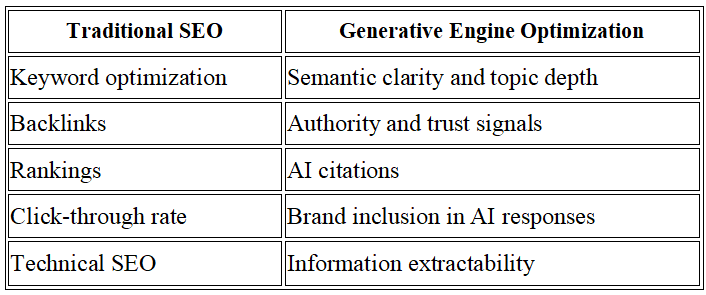
SEO brings users to your site.
GEO embeds your expertise directly into AI conversations.
Why GEO Is Critical for 2025 and Beyond
AI-driven search adoption is accelerating across industries.
Businesses that adapt early gain:
Higher brand authority
Increased trust signals
Stronger organic pipeline quality
Reduced customer acquisition costs
Competitive AI market share
Meanwhile, companies ignoring GEO risk disappearing from buyer research entirely.
When potential customers ask AI for recommendations and your competitors are cited—but you’re not—you lose visibility before the sales conversation even begins.
How Generative Engines Work vs Traditional Search
Understanding how AI systems retrieve and synthesize information is foundational to GEO success.
Traditional Search Engines
Crawl and index web pages
Rank based on 200+ factors
Display a list of URLs
Rely on user clicks
Generative AI Platforms
Interpret intent and context
Retrieve multiple knowledge sources
Synthesize information
Generate structured answers
Cite authoritative sources
How AI Chooses Sources
Generative platforms tend to prioritize:
Authoritative websites
Educational and government sources
Structured, well-organized content
Recently updated material
Clear semantic explanations
Strong entity credibility
This means content quality and clarity now outweigh keyword density.
The 6-Step GEO Implementation Framework

Step 1: Audit Your AI Visibility
Test brand mentions across major AI platforms.
Track citation frequency.
Identify competitors appearing where you don’t.
Analyze how AI summarizes your brand.
Step 2: Optimize Content Structure
Use Answer-First Formatting
Begin content with a direct, concise answer (40–60 words).
Use Question-Based Headers
Structure content around real user queries, such as:
What is Generative Engine Optimization?
How does GEO differ from SEO?
Why does GEO matter for business growth?
Build Topic Clusters
Develop comprehensive content ecosystems around core topics to build authority.
Step 3: Build Authority Signals
AI systems favor credible, verifiable expertise.
Strengthen authority by:
Adding expert author bylines
Including citations to reputable sources
Publishing case studies
Demonstrating firsthand experience
Maintaining consistent topical focus
Step 4: Implement Technical Optimization
Schema Markup
Add structured data such as:
Article schema
FAQ schema
HowTo schema
Organization schema
Author schema
Structured data improves machine readability.
Performance Optimization
Mobile-first design
Fast loading speeds
Core Web Vitals compliance
Accessibility standards
Step 5: Optimize Across Platforms
Different AI engines prioritize different signals.
For Google AI Overviews
Use FAQ and HowTo schema
Provide comprehensive coverage
Include supporting data and examples
Update content regularly
For ChatGPT & Similar Platforms
Create encyclopedic-style clarity
Establish educational authority
Provide complete topic coverage
Maintain factual consistency
Step 6: Monitor, Measure, and Refine
Track:
AI citation frequency
Brand mention sentiment
Share of AI voice
AI-attributed traffic
AI-influenced conversions
Refine content based on how AI platforms summarize and reference it.
Measuring GEO Success
Traditional SEO metrics alone are no longer sufficient.
Core GEO Metrics
AI Citation Rate
(Brand citations ÷ total relevant AI queries tested) × 100
Share of AI Voice
(Your brand citations ÷ total industry citations) × 100
AI-Attributed Revenue
Revenue influenced by AI discovery vs total GEO investment
Track not just traffic—but visibility inside AI answers.
Common GEO Mistakes to Avoid

1. Treating GEO Like SEO
Avoid keyword stuffing. Focus on clarity and completeness.
2. Providing Incomplete Answers
Anticipate follow-up questions within the same content.
3. Ignoring Platform Differences
Customize optimization for each AI system.
4. Skipping Structured Data
Missing schema markup reduces extractability.
5. Lacking Author Credibility
Anonymous content weakens trust signals.
6. Underfunding GEO
Treat GEO as a strategic growth channel, not a side experiment.
The Future of GEO
Generative AI is expanding into:
Multimodal search (text, images, voice)
Real-time synthesis
Cross-platform integrations
Mobile-first conversational search
Embedded AI search experiences in browsers and devices
Brands that build authority today will shape AI’s understanding of their industries tomorrow.
GEO isn’t a trend. It’s a structural shift in how digital visibility works.
Key Takeaways: Your GEO Blueprint
To dominate AI search:
Create authority-first content.
Optimize for semantic clarity.
Implement structured data.
Build cross-platform presence.
Monitor AI citations consistently.
Refine continuously.
The brands that win in AI search won’t just rank—they’ll be referenced.
Frequently Asked Questions (FAQ)
What is Generative Engine Optimization (GEO)?
Generative Engine Optimization (GEO) is the process of optimizing content so AI platforms like ChatGPT and Google AI Overviews can understand, trust, and cite it within AI-generated responses.
Is GEO replacing traditional SEO?
No. GEO complements SEO. Traditional SEO focuses on rankings and traffic, while GEO focuses on citations and brand inclusion within AI-generated answers.
Why is GEO important for businesses?
As more users rely on AI assistants for research and recommendations, brands must appear within AI responses to remain visible during the buying journey.
How do AI platforms decide which sources to cite?
AI systems prioritize:
Authoritative domains
Structured, well-formatted content
Clear semantic explanations
Up-to-date information
Credible expertise
How long does it take to see results from GEO?
Initial improvements in AI recognition may appear within 4–8 weeks after technical and content optimizations. Strong authority signals typically compound over 6–12 months.
What are the most important GEO ranking factors?
Key factors include:
Semantic clarity
Topic depth
Author credibility
Structured data implementation
Cross-platform authority
Consistent content updates
How can I start implementing GEO today?
Start with:
Auditing AI mentions of your brand.
Adding schema markup to key pages.
Rewriting top content using answer-first formatting.
Strengthening authority signals and citations.
Tracking AI citation performance monthly.
Ready to Get Started?
Let's discuss how we can help you achieve your goals