

Which 4 GEO Optimization Metrics Should Your Business Focus On?
The data speaks for itself. In Q2 2026, referrals from large language models (LLMs) surged 800% year-over-year, highlighting a profound shift in how customers discover and interact with brands. Unlike traditional search engines, AI platforms like ChatGPT, Perplexity, and Google’s AI Overviews provide direct, comprehensive answers—often without sending users to your website. This trend underscores the critical importance of GEO measurement, which evaluates how well your content performs in AI-powered discovery environments.
Why GEO Metrics Matter More Than Traditional SEO
Growth-stage companies face a new challenge: your content may rank for keywords, but if it’s not optimized for AI comprehension and citation, it’s effectively invisible where it counts most. Traditional SEO metrics like click-through rates and organic traffic are losing relevance as users increasingly rely on AI-generated answers.
The strategic implication is clear: companies that shift from vanity metrics to AI-focused performance metrics will dominate their market categories. The question isn’t whether to adopt GEO metrics—it’s how fast you can implement them before competitors establish authority in AI search results.
The Four Essential GEO Optimization Metrics
Effective GEO measurement requires tracking four core metrics that reveal your brand’s performance across AI-driven search platforms.
1. AIGVR: AI-Generated Visibility Rate
Definition: Measures how often your content appears in AI-generated responses relative to relevant query volume.
Reveals if content is structured and optimized for AI comprehension
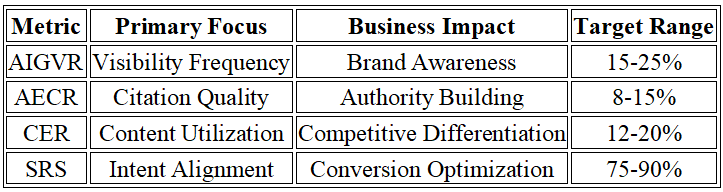
High-performing B2B brands target 15–25% AIGVR for primary topics
Princeton University and Georgia Tech studies show GEO optimization can increase AIGVR by up to 40%
2. AECR: AI Engagement & Citation Rate
Definition: Tracks how frequently AI platforms quote, reference, or recommend your content.
High AECR correlates with brand credibility and thought leadership
SaaS companies using AECR alongside traditional metrics report better revenue attribution and AI-driven pipeline growth
3. CER: Content Extraction Rate
Definition: Measures how much of your content AI platforms incorporate into responses.
High CER indicates unique, valuable content that AI systems trust
Optimizing for CER involves creating proprietary data, insights, and clear attribution
NLP-driven GEO optimization tools can boost semantic relevance and CER by up to 84%
4. SRS: Semantic Relevance Score
Definition: Evaluates how well content aligns with user intent as interpreted by AI.
Focuses on conceptual matching rather than keywords
High SRS improves AI visibility, trust, and authority across all other metrics
Target SRS for high-performing content: 75–90%
Implementing GEO Metrics in Your Marketing Stack
To maximize impact, integrate GEO metrics with your existing analytics framework instead of replacing it. This approach ensures continuity while providing visibility into both traditional and AI-driven performance indicators.
Key components of a GEO tracking system:
Data sources: AI platform APIs, content monitoring tools, semantic analysis, customer feedback, and CRM integration
Infrastructure: Custom dashboards, automated alerts, and multi-platform analytics
Reporting: Translate AI visibility into business KPIs like pipeline contribution, CAC, and revenue attribution
Early adopters like NiuMatrix report faster content improvement cycles, near real-time issue detection, and better executive buy-in for AI-optimization initiatives.
Connecting GEO Metrics to Revenue

The ultimate value of GEO metrics lies in their correlation with revenue growth:
Improved lead quality and higher intent traffic
Shortened sales cycles
Enhanced brand authority and pricing power
Attribution modeling involves tracking customer touchpoints across AI platforms, correlating AI citations with website visits, inquiries, or conversions, and measuring influence on purchasing decisions.
Industry applications:
SaaS & B2B tech: AECR and SRS for thought leadership and technical authority
E-commerce & retail: AIGVR and CER for product recommendation frequency and purchase intent
Financial services & healthcare: Enhanced verification and monitoring for compliance and accuracy
Building Your GEO Measurement Roadmap
A phased approach ensures success:
Baseline Metrics: Track primary content categories and AI platform mentions
Content Optimization: Implement structured content, FAQs, and semantic relevance improvements
Integration & Expansion: Embed GEO metrics into marketing strategy, competitive intelligence, and pipeline reporting
Most companies see measurable improvements within 90 days, with significant competitive advantage within six months. Consistent measurement and iterative optimization are key.
Transform Your AI Search Visibility
GEO metrics represent the future of digital marketing measurement, providing visibility into how customers discover and evaluate solutions in AI-driven search environments.
By mastering AIGVR, AECR, CER, and SRS, marketing executives can:
Optimize content for AI visibility
Connect metrics directly to revenue impact
Build sustainable competitive advantage in generative search
Ready to dominate AI-driven search and accelerate pipeline growth? Partner with a GEO-specialized SEO agency to implement proven frameworks and trackable AI optimization results.
FAQ: GEO Metrics & AI Marketing
Q1: What are GEO metrics?
GEO metrics measure how effectively your content performs in AI-powered search and generative platforms, including visibility, engagement, extraction, and semantic relevance.
Q2: How are GEO metrics different from traditional SEO metrics?
Traditional SEO focuses on clicks, rankings, and pageviews. GEO metrics track AI citations, content usage, and intent alignment, which matter in AI-driven decision-making environments.
Q3: Why is GEO measurement important now?
AI-powered platforms are replacing traditional search for many user queries. Measuring GEO performance ensures your content is visible, authoritative, and citable where purchasing decisions are made.
Q4: What are the four essential GEO metrics?
AIGVR – Visibility frequency in AI-generated responses
AECR – Citation quality and engagement
CER – How much content is extracted and used
SRS – Semantic relevance and intent alignment
Q5: How can GEO metrics drive revenue?
By improving AI visibility and authority, GEO metrics increase lead quality, shorten sales cycles, and enhance brand trust, which translates into higher conversions and competitive advantage.
Q6: Can GEO metrics integrate with existing analytics?
Yes. GEO metrics can be layered onto traditional reporting frameworks, dashboards, and CRM systems to provide a comprehensive view of both website and AI performance.
Q7: How long does it take to see results from GEO optimization?
Most companies observe measurable improvements in 90 days, with substantial competitive advantage within six months of consistent implementation.
Ready to Get Started?
Let's discuss how we can help you achieve your goals