


AI Sentiment Analysis: How Brands Track Customer Emotions in Real Time
AI sentiment analysis is transforming how brands understand customer emotions in 2026. By using artificial intelligence and natural language processing (NLP), businesses can analyze real-time feedback, detect emotional trends, and respond instantly—improving customer experience, brand reputation, and marketing performance.
In today’s digital landscape, customers are constantly sharing their opinions—through social media, reviews, chats, and more. But understanding how they truly feel has always been a challenge.
In 2026, AI sentiment analysis is solving that problem. Instead of manually reviewing feedback, brands can now automatically detect emotions, measure sentiment, and act on insights in real time.
This shift is helping businesses move from simply collecting feedback to emotion-driven decision-making.
What is AI Sentiment Analysis?
AI sentiment analysis is the use of artificial intelligence, machine learning, and natural language processing (NLP) to determine the emotional tone behind text or speech.
It categorizes customer sentiment into:
Positive
Negative
Neutral
More advanced systems can also detect:
Frustration
Satisfaction
Excitement
Trust
Urgency
This enables brands to understand not just what customers say—but how they feel.
Why Sentiment Analysis Matters in 2026
1. Real-Time Customer Insights
Brands can instantly analyze feedback as it happens, allowing for immediate responses and faster decision-making.
2. Enhanced Customer Experience
Understanding emotions helps businesses personalize interactions and resolve issues more effectively.
3. Stronger Brand Reputation Management
AI detects negative sentiment early, helping brands address potential crises before they escalate.
4. Data-Driven Marketing Strategies
Marketers can tailor campaigns based on audience sentiment, improving engagement and performance.
How AI Sentiment Analysis Works
Step 1: Data Collection
AI gathers data from:
Social media platforms
Customer reviews
Surveys and feedback forms
Chatbots and support conversations
Step 2: Natural Language Processing (NLP)
NLP analyzes text to identify:
Keywords and phrases
Context and tone
Emotional signals
Step 3: Sentiment Classification
Machine learning models categorize the sentiment and assign scores or labels.
Step 4: Real-Time Insights & Action
Dashboards provide insights that allow businesses to:
Monitor sentiment trends
Respond to customer concerns
Optimize campaigns instantly
Key Benefits for Businesses
1. Faster Issue Resolution
Negative feedback is identified and addressed quickly.
2. Improved Customer Retention
Understanding emotions helps build stronger relationships with customers.
3. Smarter Campaign Optimization
Marketing strategies can be adjusted based on real-time audience sentiment.
4. Competitive Advantage
Brands that understand customer emotions can respond more effectively than competitors.
Real-World Applications
AI sentiment analysis is widely used across industries:
E-commerce: Tracking product reviews and customer satisfaction
Finance: Monitoring trust and customer confidence
Healthcare: Understanding patient feedback
Hospitality: Improving guest experience through reviews and surveys
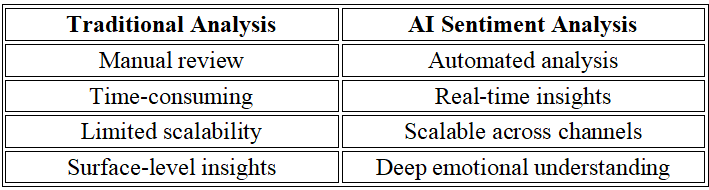
Sentiment Analysis vs Traditional Feedback Analysis
Best Practices for Implementation
To maximize the impact of AI sentiment analysis:
Use high-quality and diverse data sources
Continuously train AI models for accuracy
Combine AI insights with human interpretation
Monitor sentiment trends over time
Ensure compliance with data privacy regulations
Challenges to Consider
While powerful, sentiment analysis has limitations:
Difficulty detecting sarcasm or cultural nuances
Dependence on data quality
Potential bias in AI models
Need for ongoing optimization
A balanced approach combining AI and human insight is essential.
The Future of Emotion-Driven Marketing
AI sentiment analysis is evolving rapidly. In the future, we can expect:
Emotion-aware chatbots and virtual assistants
Predictive sentiment analysis
Deeper integration with marketing automation tools
Hyper-personalized customer experiences
Brands will not just respond to emotions—they’ll anticipate them.
How Agenoria Can Help
At Agenoria, we help businesses leverage AI sentiment analysis to:
Monitor and understand customer emotions
Improve brand reputation and engagement
Optimize marketing strategies in real time
Deliver personalized customer experiences
We help you turn customer emotions into actionable insights.
Frequently Asked Questions
1. What is AI sentiment analysis?
It’s a technology that uses AI to detect and analyze emotions in customer feedback and conversations.
2. How accurate is sentiment analysis?
Modern AI models are highly accurate, but performance depends on data quality and continuous training.
3. Can sentiment analysis work in real time?
Yes, advanced systems can analyze and respond to customer sentiment instantly.
4. What industries benefit the most?
E-commerce, finance, healthcare, hospitality, and SaaS industries benefit greatly.
5. Is sentiment analysis compliant with privacy laws?
Yes, when using consented and properly managed data, it aligns with privacy regulations.
6. Do businesses still need human analysis?
Yes, human oversight is important to interpret complex emotions and ensure strategic alignment.